
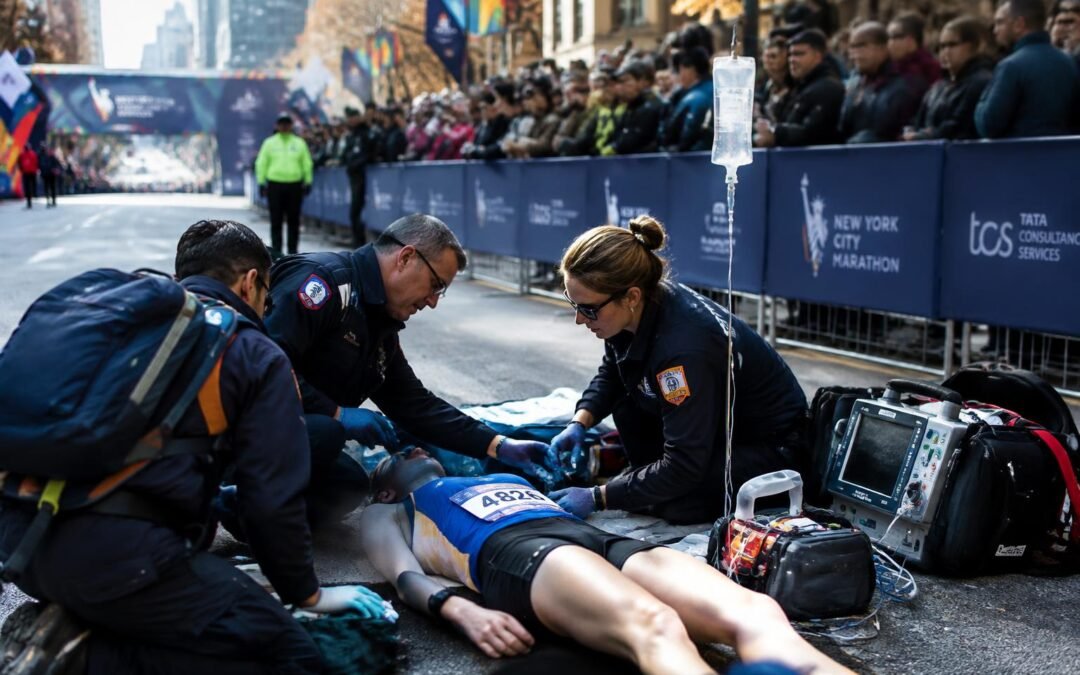
A marathon can push your muscles far beyond an ordinary workout, but a rare, serious injury called rhabdomyolysis can turn muscle breakdown into a medical emergency. The 2026 NYC Marathon story puts that risk in sharp focus: you should know that severe muscle pain, weakness, or dark urine after intense exercise warrants urgent medical attention.
Key Takeaways:
- Rhabdomyolysis happens when damaged muscle cells release their contents into the bloodstream, which can strain the kidneys and, in severe cases, disrupt the heart’s rhythm.
- After intense exercise, pain that worsens over the next two or three days, swollen or unusually weak muscles, and dark urine are warning signs that need prompt medical attention.
- Exercise-related rhabdomyolysis is rare in well-trained runners. Sudden, strenuous training, especially in hot conditions without enough fluids, can raise the risk.
What Is Rhabdomyolysis, and What Happens to Your Muscles?
Dr. Desai compares your muscle cells to water balloons: each one holds myoglobin, potassium, enzymes such as creatine kinase (CK), and other contents that normally remain inside. With rhabdomyolysis, many cells rupture at once, spilling those materials into your bloodstream. Your kidneys then have to filter the sudden load, while the damaged muscle itself can swell within its tight outer casing. That pressure can squeeze blood vessels and create a second, serious injury.
| What’s inside muscle cells | What happens when cells rupture | Possible effect |
|---|---|---|
| Myoglobin | Enters the bloodstream | Can strain the kidneys |
| Potassium | Spills into the bloodstream | Can disrupt the heart’s electrical rhythm |
| Creatine kinase (CK) | Escapes from damaged cells | Can be measured in blood tests |
| Other cellular contents | Build up in the blood | Add to the kidneys’ filtering burden |
How muscle breakdown can affect your kidneys and heart
Once myoglobin and other cell contents flood your blood, your kidneys must clear far more material than usual. Myoglobin can damage kidney tissue, and severe kidney injury may interfere with your body’s ability to manage fluid and waste. Potassium has a different danger: if its level rises too high, it can interfere with the electrical signals that control your heartbeat. That’s why a muscle injury can become a problem for organs far beyond the sore area.
What compartment syndrome means
In compartment syndrome, swelling builds inside a tight casing of tissue around a muscle group. Picture a forearm swelling within its firm outer covering: there’s little room for the tissue to expand, so pressure rises and can squeeze the blood vessels supplying the muscle. With less blood reaching the area, the muscle can be damaged further. Severe pressure may need urgent treatment to relieve the compression and protect the affected tissue.
What Causes Rhabdomyolysis, and Who’s Most at Risk?
Muscle breakdown can release potassium into your bloodstream. Because potassium helps control your heart’s electrical rhythm, a sudden change can disrupt that rhythm; severe rhabdomyolysis can become life-threatening. Your risk also depends on how your body handles exertion, heat, and other stresses. Certain groups may face higher risk, but anyone can develop rhabdomyolysis after intense exercise, an injury, or substance use.
Why sudden increases in exercise and heat can raise risk
Endurance athletes can be at higher risk, especially if they go “zero to 60 in their workouts.” If you rarely exercise and suddenly begin a strenuous program, your muscles may be pushed beyond what they’re prepared for. Hard workouts in hot weather add another concern: dehydration. For example, a demanding run in the heat without enough fluids can combine intense muscle effort with extra strain on your body.
Other risk factors to know about
Alcohol and drug use, as well as injuries, can also contribute to rhabdomyolysis. Men, Black people, people with sickle cell trait, and people with a body mass index over 40 may be at higher risk. These factors don’t mean you’ll necessarily develop the condition, but they’re worth discussing with a clinician if you’re planning strenuous training or have had a previous muscle injury.
- Build workout intensity gradually.
- Take breaks during hard exercise in hot weather.
- Pay attention to fluid intake during strenuous activity.
What Are the Warning Signs of Rhabdo?
Symptoms can range from easy to miss to hard to ignore, and dark urine deserves attention rather than a wait and see approach. Brintha Vasagar, MD, MPH, a family physician in Milwaukee, says muscle pain and weakness are common, while dark urine can signal kidney stress. Some people have no symptoms at all, so pay attention to how your body feels after a demanding workout, not just to the color of your urine.
How rhabdo can feel different from normal soreness
Ordinary soreness can follow a tough workout, which makes rhabdo difficult to spot by feel alone. A stronger warning is pain that seems out of proportion to your effort and keeps worsening over two to three days, says Desai. You may also notice muscles that are swollen, tender, or tight. True weakness is another red flag: your muscles feel unable to work, rather than movement simply hurting too much.
When symptoms may show up
Timing depends on the cause. A potassium imbalance can bring symptoms on immediately, while exertion-related rhabdo may take 24 to 48 hours to appear. Desai describes a pattern where you feel fine leaving the gym, wake up sore the next morning, then recognize by day two or three that something’s wrong. If your soreness is escalating instead of easing, or dark urine appears, seek medical care promptly.
| Sign or timing | What you may notice | Why it stands out |
|---|---|---|
| Muscle symptoms | Pain, swelling, tenderness, or tightness | Pain may feel excessive for the workout |
| Weakness | Muscles feel genuinely weak | Different from holding back because movement hurts |
| Urine | Dark urine | May reflect kidney stress |
| Onset | Immediate or 24 to 48 hours later | Timing varies with the cause |
How Is Rhabdomyolysis Treated, and How Long Does Recovery Take?
Your recovery depends on how severely your muscles have been injured and whether the damage has affected your kidneys or blood chemistry. Hospital care gives clinicians a chance to respond to changes rather than rely on symptoms alone. Even after you leave, follow-up tests and a cautious pause from hard workouts may be part of the plan; returning to a long run too soon can put extra strain on recovering muscles.
What treatment and hospital care may involve
At the hospital, you’ll typically receive IV fluids to protect your kidneys, along with blood-work monitoring and treatment of abnormalities as they appear. Exercise-induced rhabdomyolysis often means a few days in the hospital. Your care team may track myoglobin, a muscle protein released into the blood, and potassium, which can rise when muscle cells are damaged. Myoglobin usually returns to normal over a week or two; potassium may take several days.
Getting back to training gradually
Once your symptoms improve and your clinicians are satisfied with your test results, ask them how to restart exercise. A gradual return may take several weeks, with lab checks and close attention to symptoms such as worsening muscle pain, weakness, or dark urine. Start with easy activity rather than a hard interval session or a long run, and don’t increase training while symptoms persist. Your clinician can tailor the pace to your recovery.
- Keep follow-up appointments for blood tests.
- Tell your clinician if symptoms return after activity.
- Don’t resume intense training without medical guidance.
Should Runners Actually Worry About Rhabdo?
Rhabdomyolysis is rare in well-trained runners, so ordinary post-race soreness doesn’t mean you’re in danger. What matters is how your body changes over the next few days, not just how tired your legs feel at the finish. A blood test showing elevated creatine kinase the day after a race can reflect normal muscle stress; that result alone isn’t necessarily an emergency. Pay attention to the pattern of symptoms, especially if they’re getting worse.
| After a race | What it may mean | What to watch for |
|---|---|---|
| Elevated creatine kinase the next day | Can reflect normal muscle stress | Consider it alongside your symptoms |
| Soreness that eases | Often fits ordinary recovery | Notice whether pain improves |
| Pain worsening over two to three days | Warning sign | Seek medical advice |
| Weakness, muscle swelling, or dark urine | Warning signs | Get prompt medical attention |
When post-race muscle stress may be normal
After a hard race, your legs may feel sore and stiff, and a blood test the next day may show elevated creatine kinase. In well-trained runners, that enzyme rise can come from ordinary muscle stress; it doesn’t, by itself, mean you have rhabdomyolysis or need emergency care. For example, if your soreness gradually eases as you recover, that’s a different pattern from pain that keeps intensifying over the next two to three days.
Warning signs runners shouldn’t ignore
Pay close attention if muscle pain worsens over two to three days instead of easing, particularly if you also feel weak or notice muscle swelling. Dark urine is another warning sign, not just a detail to brush off after a long run. These symptoms deserve prompt medical attention, especially when they appear together. Don’t rely on soreness alone to judge what’s happening; describe when the pain began, how it has changed, and any urine color changes to a clinician.
Summing up
Rhabdomyolysis is rare, but the death of a healthy 24-year-old at the 2026 NYC Marathon is a sobering reminder that serious muscle injury can affect endurance athletes. You don’t need to panic about every sore muscle after a long run, but worsening pain, weakness, muscle swelling, or dark urine calls for prompt medical attention. Dark, tea-colored urine after a race isn’t something to wait out at home. Early evaluation can identify muscle breakdown and guide treatment before complications develop.
FAQ
Can rhabdomyolysis go away on its own without treatment?
Suspected rhabdomyolysis needs prompt medical assessment, because muscle contents released into the blood can damage the kidneys or disrupt the heart’s rhythm. Symptoms alone can’t confirm or rule it out, so a clinician may use blood and urine tests to check for muscle breakdown and related problems.
How soon can you run again after rhabdomyolysis?
There’s no set return-to-running timeline; it depends on the severity of the muscle injury, kidney function, and recovery on follow-up tests. Don’t restart hard training until a clinician clears you, and build back gradually, since intense exercise too soon can worsen muscle damage.
How can runners lower their risk of rhabdo during training?
Increase training gradually, avoid sudden jumps in workout intensity, and be cautious about hard exercise in hot conditions, especially if you’re dehydrated or unaccustomed to the effort. These steps can lower risk, but they can’t prevent every case, so severe or worsening muscle pain, swelling, weakness, or dark urine needs medical attention.
