
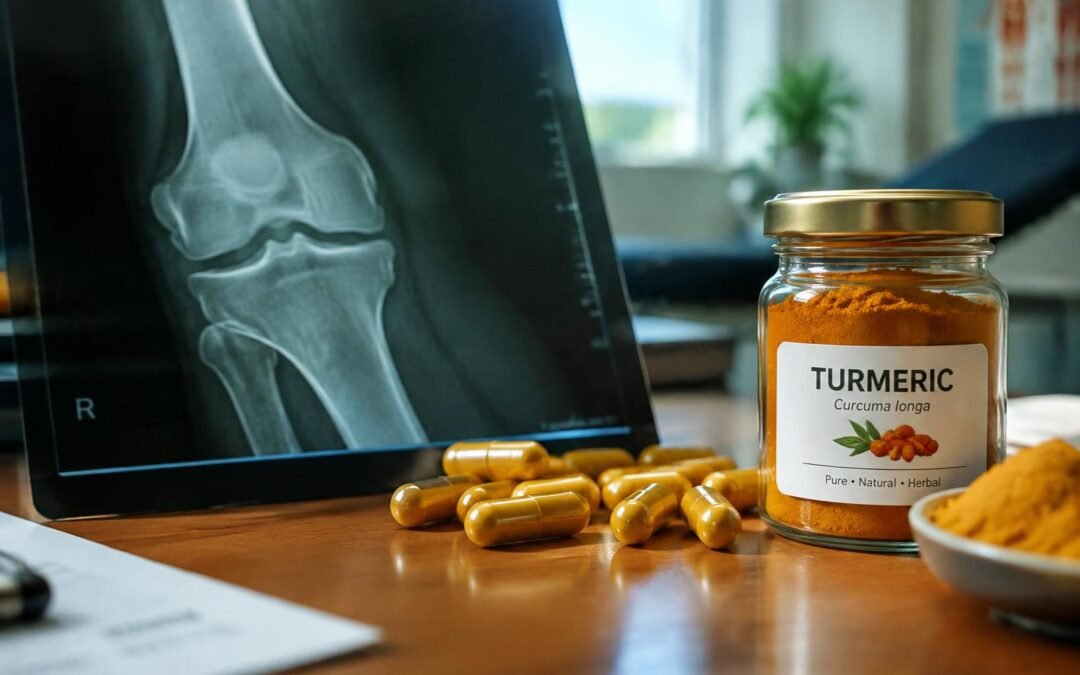
Turmeric contains curcumin and other compounds that show anti-inflammatory effects in laboratory studies, which makes the spice tempting if your knees ache. Knee osteoarthritis involves low-grade inflammation in the joint lining, contributing to pain and stiffness. But effects seen in a lab don’t necessarily mean a turmeric supplement will ease your symptoms.
Key Takeaways:
- In the reviewed trials, turmeric reduced knee pain only slightly more than a placebo, and the average improvement fell short of the level researchers considered meaningful to patients.
- Turmeric showed little or no difference in physical function or quality of life. Some people may feel better, but the evidence is uncertain and doesn’t show that turmeric works better than NSAIDs such as ibuprofen.
- The trials were small and short, and the products varied. If you take a turmeric supplement, tell your healthcare team, since supplements can cause side effects or interact with medicines.
What Did the Review Actually Find?
The review focused on oral turmeric extract and curcuminoids, not turmeric blends with other herbs. Researchers searched medical databases and trial registries for randomized trials in adults diagnosed with osteoarthritis using standard criteria; only knee arthritis studies qualified. Across nine trials involving about 1,200 people, participants averaged 52 to 62 years old, and roughly two-thirds were women. The trials ran from four weeks to three months in Australia, Belgium, India, and Thailand.
How much did pain and function change?
Against placebo, turmeric reduced pain by about 0.7 points on a 0-to-10 scale, short of the 1.5-point change considered meaningful to patients. Physical function and quality of life changed little or not at all. Still, two small trials found that about 19 in 100 people taking turmeric rated treatment a success, compared with 11 in 100 taking placebo. “Some people do benefit,” says Neha Shah, MD, a Stanford rheumatologist who wasn’t involved in the review.
What did participants compare turmeric with?
Four trials compared turmeric with a placebo, four with NSAIDs such as ibuprofen, and one with acetaminophen (Tylenol). Turmeric wasn’t shown to work better than NSAIDs, and the researchers were very uncertain about its side effects. Lead author Ivan Shirinsky, MD, of the Institute of Preventive Medicine in Novosibirsk, Russia, says the changes in pain and function may not be large enough to matter to patients. So if you’re weighing turmeric against standard pain relief, the review doesn’t establish an advantage.
| Comparison or outcome | Review finding |
|---|---|
| Turmeric vs. placebo | About 0.7 points less pain on a 0-to-10 scale |
| Meaningful pain change | 1.5 points |
| Treatment rated a success | About 19 in 100 with turmeric; 11 in 100 with placebo |
| Turmeric vs. NSAIDs | No evidence turmeric worked better |
Why Are These Findings Less Positive Than Earlier Reviews?
The gap may come down to which trials researchers considered reliable, not to a new set of results pointing in the opposite direction. Shirinsky says his team’s main difference was leaving out studies used in earlier reviews. So, if you’re comparing conclusions, check what counted as evidence: a turmeric cream, a combination product, and an oral turmeric supplement aren’t interchangeable treatments.
What studies were left out?
Shirinsky’s team excluded 10 trials after raising concerns about proper registration, ethical approval, and whether participant details and results were plausible. The trial authors either didn’t respond to questions or couldn’t fully resolve the concerns. That doesn’t prove the reported findings were false, but it does mean you should be cautious about relying on them. The team also applied stricter inclusion criteria and a more rigorous assessment of each study’s trustworthiness.
How did earlier reviews differ?
Earlier reviews generally reported that turmeric eased pain and improved function compared with placebo, and worked about as well as NSAIDs. But their evidence could include turmeric creams, products that paired curcumin with other active ingredients, and participants diagnosed with osteoarthritis by X-ray alone. Those aren’t the same as trials of turmeric alone in people whose knee osteoarthritis was confirmed using stricter criteria, so the comparison may not answer the same question.
- Placebo comparisons ask whether a treatment beats an inactive substitute.
- NSAIDs are a separate class of pain-relieving medicines.
- Curcumin is an active ingredient found in turmeric.
Does Turmeric’s Anti-Inflammatory Effect Carry Over to People?
For your knee, the key question is whether effects seen in a lab translate into meaningful relief after you swallow a supplement. Turmeric has a long history in cooking and traditional medicine, but compounds that act on inflammation in controlled experiments don’t automatically behave the same way inside your body. Curcumin is one of those compounds; how much reaches your bloodstream may shape whether the lab findings matter for everyday movement, such as climbing stairs.
What happens in the lab?
In laboratory studies, curcumin and other turmeric compounds called curcuminoids have shown anti-inflammatory properties. Janet L. Funk, MD, professor of medicine and vice chair of research in the department of medicine at the University of Arizona in Tucson, explains that curcuminoids can block NF-kB. Think of NF-kB as an on switch: it helps prompt production of many substances that drive inflammation. Blocking that switch may reduce inflammatory activity, at least under laboratory conditions.
Why might oral absorption matter?
The authors note that curcuminoids are poorly absorbed when you take them orally. That creates a gap between blocking NF-kB in a lab and getting enough of a compound into your body to affect an arthritic knee. A capsule may contain curcumin, but its presence on the label doesn’t show how much your body absorbs or whether it reaches the joint. So lab results alone can’t tell you how much pain relief to expect.
| Question | What the evidence says | What it means for you |
|---|---|---|
| What has been seen in labs? | Curcuminoids can block NF-kB, an inflammation related switch. | A possible mechanism, not proof of knee relief. |
| What happens after swallowing? | Curcuminoids are poorly absorbed orally. | The amount reaching your body may be limited. |
| Who explains the mechanism? | Janet L. Funk, MD, of the University of Arizona in Tucson. | Her explanation describes laboratory effects, not a guaranteed result. |
How Certain Can We Be About the Results?
Funk says the review used strict criteria to select studies, making them more uniform and possibly higher quality. Still, researchers rated the evidence “low certainty,” so the true effect could be quite different from what the results suggest. That matters if you’re weighing a turmeric supplement against other ways to manage knee pain: the findings offer a signal, not a firm prediction of what you’ll experience.
What limits the evidence?
Every trial was small and short, and all focused on knee osteoarthritis, so you can’t assume the findings apply to other joints or longer-term use. A large share of participants were in India, while most trials received industry funding. Six completed placebo-controlled trials were never published, too. That missing evidence leaves you with an incomplete picture, and the available studies may not reflect what you’d see in a broader group of patients.
Why do product differences matter?
Funk says the trials tested different turmeric products, and researchers often didn’t define or verify their contents. So a result for one trial’s capsule may not tell you much about a bottle on your shelf, whose ingredients or formulation could differ. Confidence in reported side effects is even lower than confidence in the main findings, making it harder for you to judge whether a particular product is both useful and well tolerated.
- Ask your clinician whether a supplement could interact with medicines you take.
- Check the product label for its ingredients and serving instructions.
- Keep track of any change in pain or side effects after starting a supplement.
Should You Keep Taking Turmeric?
Funk says turmeric’s benefits for knee arthritis are possible, but they aren’t proven and are likely modest at best. If you started taking it without medical advice, the review’s findings may give you reason to reconsider; if you feel it helps, your preferences and the cost may guide your choice. Either way, don’t make the decision in a vacuum. What you take can matter when your care team is weighing symptoms, other medicines, and potential side effects.
What should you discuss with your care team?
If you already take turmeric, Shirinsky recommends discussing the review’s findings with your healthcare team. Tell them why you started, what product you use, and whether you’ve noticed any change in your knee symptoms. If you began taking it on your own, ask whether continuing makes sense for you. When you feel it helps, your preferences and the cost can also factor into the decision; your clinician can help weigh those against the uncertain, likely modest benefit.
Why is it important to mention supplements?
Funk and colleagues reported a case of liver failure linked to turmeric in a woman who hadn’t told her healthcare providers she was taking it. Her liver function worsened until she suspected turmeric, stopped taking it, and eventually returned to normal. That case doesn’t mean turmeric will harm you, but it shows why your team needs a full list of supplements. Funk says that information can help identify possible causes of liver problems and check for side effects or interactions with medicines and other supplements.
| Your situation | Practical next step |
|---|---|
| You already take turmeric | Discuss the review’s findings with your healthcare team. |
| You started it on your own | Ask whether continuing makes sense for you. |
| You feel it helps | Weigh your preference and the cost against uncertain, likely modest benefits. |
| You take other medicines or supplements | Tell your care team so they can check for interactions and possible side effects. |
To wrap up
Turmeric may not give you meaningful relief from knee arthritis: the review found its average effect on pain fell below the threshold considered worthwhile. Evidence about possible benefits and side effects is still uncertain, so a supplement shouldn’t replace a treatment plan you’ve made with your clinician. Talk with your healthcare team before taking it, especially if you also use medicines or other supplements, such as a blood thinner or a daily multivitamin.
FAQ
Is turmeric worth taking for knee arthritis?
Turmeric may not be worth taking specifically for knee arthritis, since the reviewed trials found only a small average pain improvement and little or no change in function. Some people may feel better, but benefits aren’t certain, and turmeric wasn’t shown to work better than anti-inflammatory drugs.
How long should I take turmeric before deciding if it helps my knee?
There’s no established trial-based timeframe for deciding whether turmeric helps knee arthritis. Studies lasted four weeks to three months, but that doesn’t show how long an individual should try it; ask your care team before starting or continuing it.
What are the risks of taking turmeric supplements for knee pain?
The risks of turmeric supplements for knee pain aren’t well established by the available trials. Supplement products can differ, and they may not be suitable alongside some medicines, so tell your care team what you’re taking and ask about potential interactions.
